Showing posts with label mixed media. Show all posts

Wednesday, August 31, 2011

Only 3 sleeps until my 'Hot Stuff #1' textile art workshop in Melbourne on Saturday. Book now!

The 'Hot Stuff #1' textile art workshop run by ATASDA VIc is coming up quickly! We still have around 5 places so if you are interested in learning how to distress synthetic fabrics with a heat gun, how to colour and distort Tyvek and how to incorporate products like Angelina Fibre and Textiva Film (fantasy film) into your work book now!

To book for Saturday call Barbara on  0419 396 695. For more information about the workshop please see the flyer in my last blog post and feel free to ask me questions in the comments section on this blog. All the textile art materials are available for a materials fee of $5 per person so don't fret if you don't have any Angelina or the like at home.


A sample of the type of heat distressed mini-quilt class participants will be making. This piece incorporates synthetic organza and satin plus Angelina fibre, metal leaf and Textiva foil. It's machine stitched with a metallic rayon thread. We will cover how to freemachine these sorts of works in the class though they can be just as effective when sewn with a straight stitch grid.


A close up of the above quilt. Click to enlarge each of the pics.


This unremarkable looking work is the same piece before being selectively heat gunned.

We will be painting and heat distressing some Tyvek too. (click to enlarge the photo!)
From top clockwise:
1. Tyvek painted with silver acrylic then put through and inkjet printer, stitched and ironed. 2. Tyvek painted with Lumiere paint and then stitched, solder cut and heat gunned. 3. Tyvek painted and embellished with fused organza snippets and ironed  4. Painted and stitched Tyvek, ironed.


You'll go home with lots of ideas for how to use your heat tools and heat alterable products. The workshop runs from 11am through to 3pm and costs from $40 per person, however for full details please see the flyer below. Materials lists are emailed on booking.

Hope to see you there!! 
- Neroli

Saturday, May 29, 2010

Interview series: Lorraine Roy - Textile and Fiber Artist


Lorraine Roy is an award winning contemporary mixed-media textile artist from Dundas, Ontario,Canada who incorporates sewing, collage, embroidery, photo transfer, quilting and thousands of fibre and thread snippets into her work. Lorraine is a full-time textile artist with many international exhibitions to her name. She works from her home studio with her husband fine art photographer Janusz Wrobel.

As many of you know i've become a bit of a Facebook junkie in recent months and part of the reason for that is the frequency i've been stumbling upon some of the most amazing artists and their works. I found Lorraine Roy this way and after taking a look through her website and reading the quite unique techniques she uses I just knew I had to ask her to do an artist interview.

Lorraine's horticultural background and subsequent research regularly inspire her wonderful imagery. Landscapes that combine realism and abstraction combine with symbols from dreams, mythology and memories to create organic conceptual pieces that make the most of the rich medium combinations.


'The Seven Days of Creation' 69x80" (175 x 203cm) 
2008 Wall hanging, Commission, SOLD
Click pic to enlarge
Cotton, silk, synthetic and metallic fabrics and threads, nylon tulle. Cotton batting. This is Lorraine's favourite work. Five separate quilts were created and then hung together.


  How long have you been quilting and what first drew you to it? 
I have never NOT worked with fabric, beginning with sewing (from the age of 6), but ironically I never learned to make a proper quilt. I have been a professional textile artist for just over 20 years, but my formal education is in Horticulture.
'Between Now and Then' 36x48"  (91 x 121cm) 2009 SOLD
Click pic to enlarge
Framed textile incorporating cotton, silk, synthetic and metallic fabrics and threads, nylon tulle.


 How would you describe your style now? 
Painting with fabric… it’s a mixture of machine collage, appliqué, embroidery and quilting. I call my main technique "collage with nets". I love how it allows me to explore the freedom of line and shape that exists in the world of painting without compromising the intensity of colour and texture that you can achieve with fabric.


I begin with a plain fabric ground. On this surface I drop hundreds, sometimes thousands of tiny bits of cut fabrics and threads (of any kind – natural, synthetic, metallic) until I reach a depth and texture that pleases me. I then pin transparent netting on top, usually nylon tulle, which holds everything in place. The layers are then machine stitched together. This new fabric is now ready for further surface work: machine applique, embroidery, collage, and, more recently, photographic transfers from my photographer husband’s huge collection of natural images (www.jwrobelphoto.com). The finished surface is then quilted over batting and backing to fix the shape and enhance textures and lines. 
The above shows snippets of threads, scraps of fabric and yarn scattered over a backing fabric. Below is the same piece after being covered in netting and partly stitched.


 How has your style evolved? 
After many wearable fashion disasters, I learned that I had an aptitude and passion for hand embroidery. During my teens and onward I absorbed nearly every embroidery technique and was even teaching them at one point. But as you may suspect, it’s a slow medium. The transition to my new techniques took a number of years and lots of experimentation.


 Apart from quilting what else to you do within the industry? 
I occasionally teach workshops on a freelance basis (teaching my techniques or design). Lately I have been organizing my own, by renting facilities in a lovely historic church just around the corner. I even provide excellent lunches and it’s lots of fun. Also, I do some public speaking and presentations, and trunk shows, about my work and/or about native trees and art.
Red Maple  2008  28x32" (71 x 81cm)  Wall hanging  SOLD
Click pic to enlarge
Cotton, silk, synthetic and metallic fabrics and threads, nylon tulle. Cotton batting.


 What's the best advice you could give someone who wants to try quilting or textile art for the first time? 
Don’t let anyone burden you with rules.. if you feel excited and it’s breaking a rule, then go for it.


 Do you exhibit your work? 
Over the years I have exhibited extensively… in commercial and public galleries and plenty of unlikely places too. I love showing my work and it’s the way I connect with viewers and clients.
Buried Treasure  30x10" (76 x 25cm) 2009  $725 USD
Click pic to enlarge
Framed textile incorporating cotton, silk, synthetic and metallic fabrics and threads, nylon tulle.


 How do you go about finding and selecting galleries? 
Sometimes galleries approach me directly or via my website, but more often I approach them. First I make sure they are a good fit for my work, then I speak to other artists to find out what their experience is with the gallery. After that I follow the protocol that most galleries post on their site. I haven’t needed to do that in a few years… I now have just the right number and quality of commercial galleries.


I also do a few very carefully selected Commercial fine art shows (where each artist has a booth) – this is an excellent way to meet the public and increase my mailing list. I only do shows that are well juried and have high standards. They are not cheap, but well worth the investment.
Sacred Tree #1  12x12" (30x30cm) 2010  $425 USD

Click pic to enlarge
Framed textile incorporating cotton, silk, synthetic and metallic fabrics and threads, nylon tulle.

 Do you belong to any quilt associations? 
No, I don’t belong to any quilt associations. Although I do miss that kind of camaraderie, it’s more useful and interesting to belong to Naturalist clubs, Fine art clubs, or any groups outside the textile community. This keeps my ideas and work fresh.


 What would you recommend people do who want to seriously get into textile art? 
Hang out with artists in all media. Learn and study all kinds of things, not only textile art and techniques. Bring in every experience you have. Don’t let anyone tell you what to do and how to do it. Be very selective of your critics. Try to build a broad income base by diversifying, using all your strengths and passions.
Sumac Ridge  24x41"  (61 x 104cm)  2010  Wall Hanging  SOLD
Click pic to enlarge
Cotton, silk, synthetic and metallic fabrics and threads, nylon tulle. Cotton batting.


 What inspires you? 
Over the years, my work has become a blend of all my interests: nature, science, spirituality, literature, arboriculture, botany, environmental issues, my childhood on a farm … It’s a long list! I am best known, however, for my portrayals of native trees. Since my BSc in Horticulture, I’ve done a lot of research on culture, symbolism, mythology, native uses, stories, poems… and the more I learned, the more fascinating trees became. So that’s an ongoing inspiration.
Spring Aspen  30x15"  (76 x 38cm) 2010  Framed textile SOLD
Click pic to enlarge
Framed textile incorporating cotton, silk, synthetic and metallic fabrics and threads, nylon tulle.


 What sewing machine / threads etc do you use? 
I have 2 Berninas: an old regular one (made in Europe), and an even older industrial one. Both have free motion options. I don’t need anything fancy, just a strong motor and reliability. I use all kinds of threads, but prefer rayon for its shine and strength.
Lorraine's home studio
Her smaller scraps are bagged by colour and stored by shade. Bigger pieces are sorted into wire draws.
Below is a close up of her bagged scraps and a photo of her Hillcrest studio in the summer time.


 Do you have any formal art training? Do you think it's necessary? 
I don’t have formal art training. I don’t think it’s necessary but I’m sure it can’t hurt.


 What's the most rewarding thing about your career? 
Art is my way of sharing how I see and feel about the world. When people see it, they know something about me, much better than when I open my mouth. This makes it easier for a shy person like me to make connections and bring those fine souls my way. Everything evolves from there.


 How did you learn the techniques you use? 
Mainly through experimentation and looking at other artists’ work.


 What are your favorite / least favorite parts of the quilting process? 
Endless pinning. I don’t enjoy pinning. :(  Or putting on the sleeve at the end... (huge sigh). But frankly, there is very little I don’t love about every stage of my process.


Associated Links:


Lorraine's website 


Collage with nets technique in detail


Lorraine's book 'Saving Paradise'


Follow Lorraine workshops and artworks on her Facebook page


Email Lorraine to sign up for her workshop mailing list or to purchase art


I hope you enjoyed this interview and love to read your comments, please leave them by clicking on the 'comments' link below. –Neroli Henderson


Share on Facebook

Sunday, April 11, 2010

Interview series: Mixed Media Artist, Jane Davila

This weeks interview is with US based mixed media artist, writer, tutor and general all round star – Jane Davila!


Jane writes a regular business and marketing column for Quilting Arts Magazine (my favorite textile mag), has produced 3 really informative books (her 3rd 'Jane Davila's Surface Design Essentials' is just out) and teaches workshops internationally. On top of all of this she somehow manages to fit in making and selling her own art, designing websites, taking her patchwork store on tour to expos around the states and has guest starred on Quilting Arts TV. Not to mention taking the time to fill in interviews for little known Australian blogs :)


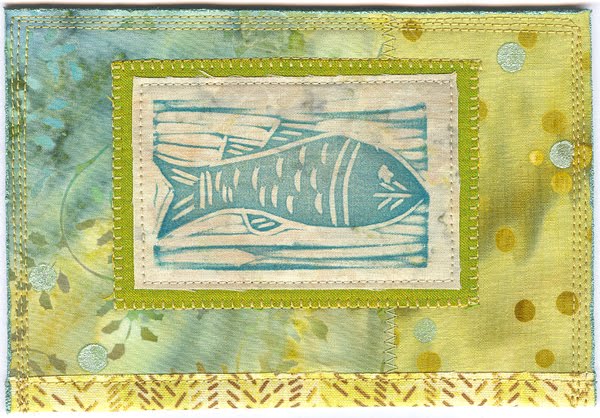
'Woodcut Fish' fibre art postcard 4"x6"
Click to enlarge pic
Cotton fabrics, block print, acrylic ink and pearlescent ink, metallic acrylic paint

 1. How long have you been quilting and what first drew you to it?  
I started out as a printmaker and came to quilting when my mom and I opened a quilt shop, The Country Quilter, in 1990 where I got a really good grounding in all of the basic quiltmaking techniques. I love the tactile quality of quilts, it's the same thing that drew me to printmaking – the texture and colors and hands-on processes.


'Strings' 6"x6"
Small fiber piece mounted on stretched canvas, cotton & silk fabrics, stamp, acrylic ink, linen floss

  2. How would you describe your style now? 
I'm definitely an art quilter although I still make pieced quilts occasionally for fun.

 3. How has your style evolved? 
I began with traditional quilts and quickly progressed to more contemporary quilts. Then in 2002 I began making art quilts when I realized that I could bring my art training and quilt training together. My studio space has been set up with my style of work in mind, so that all my favorite materials are close to hand.


Jane's gorgeous studio features lots of natural light, bookcases packed with stunning natural fabrics, paper displayed over rods and a dozen other things I could really get used to having around! Jane made most of her studio furniture herself including the floating workspace in the centre of the room. See her blog for a how she did it here.


 4. Apart from creating art what else to you do within the industry? 
I write books about art quilting for C&T Publishing (book #3, Surface Design Essentials, just came out!), I teach internationally, I write a column for Quilting Arts magazine called Minding Your Business about the business side of being an artist, I teach online courses as well as workshops in my studio, I have a blog, I tweet and I've got several products in development for the art quilting market. I have a sorely-neglected etsy store and I design websites for artists and others. What I don't have enough of is hours in the day for all the ideas in my head!


Last year in March my Mom and I closed our retail store after nearly 19 years. She has retired with my dad (and is finally getting the hang of it!) and I have taken our shop online and out on the road, vending at quilts shows around the country. Flourish, the name of my art quilting supply company, can be found at www.countryquilter.com

'El Diablito' 5.5" square
Cotton fabrics, hand-dyed wool, Loteria playing card, distress inks, hand and machine stitched

 5. What's the best advice you could give someone who wants to try quilting or textile art for the first time? 
Start with a manageable-sized project. Don't start with a king-sized quilt! I think that if you have a positive first experience and you finish what you start in a reasonable amount of time, you'll be more likely to continue than if you bite off too much and get discouraged.

 6. Do you exhibit your work? 
I do. I no longer apply to quilt shows and have much more luck with all media or mixed-media shows. As my work diversifies and moves farther away from traditional quilts, I find that gallery venues are better choices for me. I also work small and my work gets lost at regular quilt shows hanging next to bed quilts whereas galleries and art centers are better equipped to deal with making small work look great.


'La Sirena' 5.5" square
Cotton fabrics, hand-dyed wool, Loteria playing card, stamped text, hand and machine stitched


 7. How do you go about finding and selecting exhibitions? 
I subscribe to a couple of art magazines that list calls for entry and I haunt the internet – it's a tremendous resource for finding shows.

 8. Do you belong to any quilt associations? If so why did you join these ones? 
I belong to Studio Art Quilt Associates (SAQA) and Surface Design Association (SDA) as well as the Nature Printing Society. I had let my membership to some local fine art guilds lapse due to lack of time and funds but plan to re-join this year. I try to find groups of like-minded people, although I don't tend to be a big joiner. I do also belong to some interesting online groups for assemblage and collage artists.


 9. What would you recommend people do who want to seriously get into textile art? 
Study a wide variety of techniques to start to narrow down where your specific interest lies. Take classes from a number of teachers in different venues if you can. Remember that once you've learned and mastered various aspects of your craft it is necessary to produce a lot of work on a consistent basis to develop your "voice", your unique viewpoint. Take in lots of information from lots of sources, internalize and process it and let it out as your original expression. Keep the parts of what you learn that work for you and discard what doesn't.


 10. What inspires you?  
So much! Color combinations in magazines and art, music, lyrics, poetry, nature, words. I carry a little Moleskine sketchbook with me and constantly doodle in it.

 11. What sewing machine / threads etc do you use? 
I have an old Bernina that I adore. It does just enough and doesn't do anything unnecessary for me. I love cotton threads for machine sewing, especially hand-dyed and adore linen thread for hand stitching.

 12. Do you have any formal art training? Do you think it's necessary? 
I am almost entirely self-taught and I continue that education every day. I am endlessly curious about art and life and science and spend a lot of time studying and researching. I do think that having a solid grounding in the basics of art are absolutely necessary to create successful artwork. 


'Anodyne III' 9"x12"
Mixed media fiber collage, cotton fabrics, paper and paper mesh, image printed on linen fabric and hand-colored, stamped text, distress inks, mah-jong tile, over-printed with found objects, hand and machine stitching, chunky zipper edging

 14. What's the most rewarding thing about your career? 
I love teaching and getting a chance to encourage people to try new things and challenge themselves. I love creating art and pushing myself to explore.

 15. How did you learn the techniques you use? 
I learned my basic quilting skills from my mom and from books. Art quilting techniques I learned by experimentation, from books and the internet.

 16. What are your favorite / least favorite parts of the quilting process?
I like the composing part the best, where I audition fabrics, cut and lay out pieces and start thinking about the quilting lines. I like edge-finishing the least so I don't often use traditional bindings on my quilts.

 17. What is your favorite technique? 
I love to paint on fabric. I don't have the patience for dyeing fabric and I try to avoid toxic chemicals and processes in my work, so painting with acrylic paints and inks suits me. I can get a lot of the same effects that dyers get with my paints and inks and there's little to no prep, no setting and no hazardous materials or dust masks involved. To get a beautiful background wash on fabric I add a small amount of acrylic paint or acrylic ink to a container of water and simply brush it onto prewashed white fabric. I can use more than one color, I can throw sea salt on the wet paint for star burst effects and I can scrunch, fold or lay the wet fabric over a surface for even more textural interest in the finished fabric. The paint or ink changes the hand of the fabric only minimally and is as permanent as dyed fabric. And I can whip up as small or as large a piece as I need in exactly the color(s) I need.

'Gyotaku' 7.5"x9.5"
Mixed media collage on bristol board, printed mulberry paper, gyotaku print on cotton fabric, stamped text, transfered text, embossed and printed papers, cotton fabrics

 For more on Jane: 

Books (all available through C&T Publishing):
• Art Quilt Workbook (co-authored with Elin Waterston)
• Art Quilts at Play (co-authored with Elin Waterston)
• Jane Davila's Surface Design Essentials

DVD's:
• One-Page Book (Quilting Arts workshop dvd)
• Jane & Elin Teach You Art Quilting Basics (C&T Publishing)

You can purchase autographed copies of all Jane's books, or sign up (if you're quick, it's just started!) for her online 'Jump Start Your Art Career' course by emailing Jane.

View more of Jane's work on her website or check out her etsy store.

I love feedback! Please comment below if you have any thoughts on this article or what you'd like to see more or less of in future interviews. –Neroli Henderson

Share